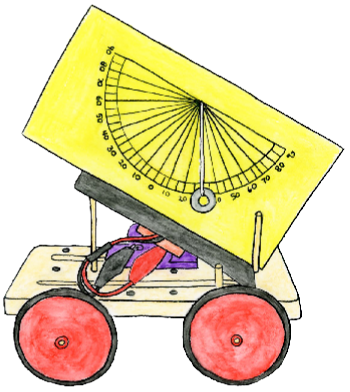
Explore how the engineering design process is used to make a more efficient car!
Students use engineering design principles and iterative prototyping as they design and build a care that 1) moves, 2) goes straight, 3) goes fast, and 4) can climb a hill. Students have choices of materials throughout the design process such as gears, propellers, motors, and solar cells. As they collect data and draw their models, students mimic the engineering design processes used in Dr. Kurt Barth’s lab at CSU to design cutting-edge solar panels.
Science and Engineering Practices include: 1) asking questions and defining problems; 2) planning and carrying out investigations; 3) constructing explanations and designing solutions
Crosscutting Concepts include: 1) cause and effect; 2) systems and system models; 3) energy and matter in systems; 4) structure and function
Next Generation Science Standards: Disciplinary Core Ideas
- ETS1.A: Defining and Delimiting Engineering Problems Possible solutions to a problem are limited by available materials and resources (constraints). The success of a designed solution is determined by considering the desired features of a solution (criteria). Different proposals for solution can be compared on the basis of how well each one meets the specified criteria for success or how well each takes the constraints into account.
- ETS1.B: Developing Possible Solutions A solution needs to be tested and then modified on the basis of the test results, in order to improve it. At whatever state, communicating with peers about proposed solutions is an important part of the design process, and shared ideas can lead to improved designs.
- ETS1.C: Optimizing the Design Solution Different solutions need to be tested in order to determine which of them best solves the problem, given the criteria and the constraints. Criteria may need to be broken down into simpler ones that can be approached systematically, and decisions about the priority of certain criteria over others (tradeoffs) may be needed.
Class Requirements
- 4th grade and up
- Moderate teacher preparation
- One to two class periods
- 30 students or less working in pairs
- Science notebooks
- Clear hallway and/or sunny level sidewalk
Solar Cars STEM Kit Resources
- Solar Cars STEM Kit Use Instructions (complete teacher guide)
- Science Notebook Template (for use in lieu of Science Notebooks)
- Science Notebook Template (Spanish version)
- Solar Cars STEM Kit Instruction Booklet
(available upon request – email name and school to Dr. Andrew Warnock) - Solar Cars Tutorial (video)
- Engineering Design Graphic
- SunWind Solar
Borrowing Solar Cars STEM Kits
There is no charge to educators who wish to borrow any of our STEM kits. We appreciate applications be submitted at least 2 weeks in advance of the desired use date. The Loan Application Form require you to confirm your email address before it will be sent to the NSEOC – so once you click submit, check your email (including the junk folder)! You should also get a copy of the form for your records via email, if you don’t, please contact Jordan Conley (jordan.conley@colostate.edu).
- For educators in the immediate area of Fort Collins (i.e.: Greeley, Loveland, Ault, Windsor, Johnstown, etc.), we ask that you select the local pick-up option on the Loan Application Form.
- For educators in Colorado outside of the immediate Fort Collins area, please select the local pick-up option on the Loan Application Form and the kits will be shipped to you.
- Educator Feedback Survey – must be completed after returning kits to the NSEOC and before another kit can be requested