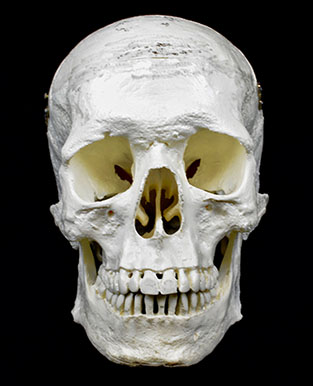
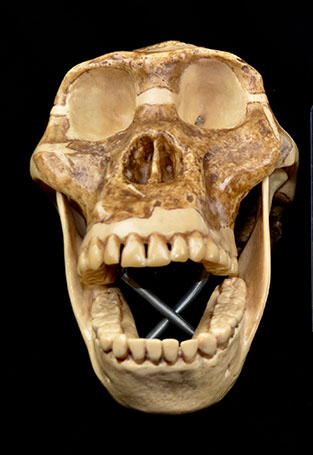
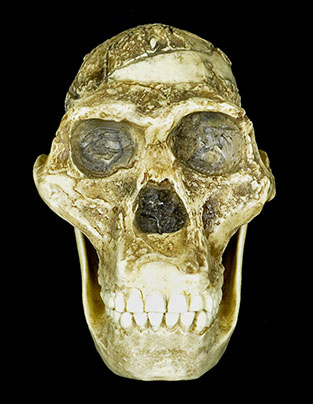
Explore how the physical characteristics of hominid skulls changed over time!
A set of 14 actual sized hominid skulls (2 of each for a total of 7 species) comes with calipers that allow students to measure parameters of each skull such and cranial capacity, sagittal crest, foramen magnum, etc. Students use the measurements and information cards to make inferences about hominid evolution. This set does not come with the usual STEM kit booklet or a storyline, but there are teacher-designed activities available to use with the skulls. Dr. Ann Magennis at CSU selected these skulls to represent key evolutionary changes.
Science and Engineering Practices include: 1) developing and using models; 2) analyzing and interpreting data; 3) using mathematics and computational thinking; 4) obtaining, evaluating, and communicating information
Crosscutting Concepts include: 1) patterns; 2) structure and function; 3) stability and change of systems
Class Requirements
- 7th grade and up
- Moderate teacher preparation
- One to two class periods
- Science notebooks
Hominid Skull Set Resources
- Hominid Skull Cards
- Skull Anatomy
- Hominid Evolution Activity – created by Kari Keever
- Hominid Skull Comparison Data Sheet (for Evolution Activity)
- Hominid Evolution Activity Rubric
- Human Evolution Activity – created by Vicky Jordan
- Human vs. Ape Trait Differences Presentation – created by Mike Viney
- Fossil of the Family Hominidae Presentation
- Becoming Human (website)
- Introduction to Human Evolution (website)
- Why Teach Evolution? (from Teaching About Evolution and the Nature of Science)
Next Generation Science Standards: Disciplinary Core Ideas
- MS-LS4.A: Evidence of Common Ancestry and Diversity Anatomical similarities and differences between various organisms living today, and between them and organisms in the fossil record enable the reconstruction of evolutionary history and the inference of lines of evolutionary descent.
- HS-LS4.B: Natural Selection Natural Selection occurs only if there is both 1) variation in the genetic information between organisms in a population and 2) variation in the expression of that genetic information – that is, trait variation – that leads to differences in performance among individuals. Traits that positively affect survival are more likely to be reproduced and thus are more common in the population.
Borrowing the Hominid Skull Set
There is no charge to educators who wish to borrow any of our STEM kits. We appreciate applications be submitted at least 2 weeks in advance of the desired use date. The loan application forms require you to confirm your email address before it will be sent to the EOC – so once you click submit, check your email (including the junk folder)! You should also get a copy of the form for your records via email, if you don’t, please contact Jordan Conley (jordan.conley@colostate.edu).
- Local Pick-Up Loan Application Form – these skulls are only available for local pick up (we will not ship them)
- Educator Feedback Survey – must be completed after returning kits to the NSEOC and before another kit can be requested
It is not the strongest of the species that survives, nor the most intelligent, but the one most responsive to change. – Charles Darwin