Explore how digital information travels around the world so quickly!
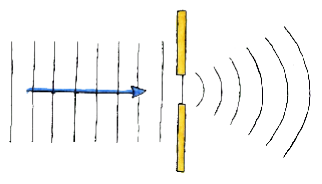
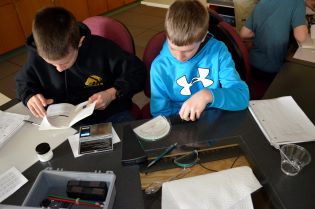
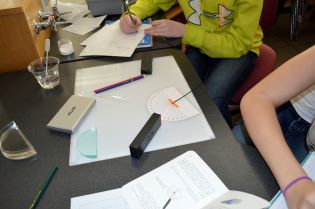
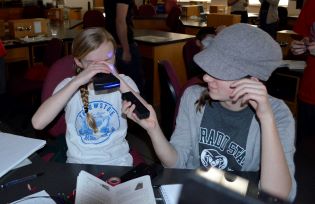
The storyline of this kit has students exploring properties of light including reflection, refraction, diffraction and wavelength. Students then experiment with fiber optic cables to investigate how digital data is transferred from one place to another. Students use Morse code to send text messages to each other. Drs. Kaarin Goncz and Martin Gelfand helped to develop these activities mimicking experiments they are doing in their physics labs at CSU.
Science and Engineering Practices include: 1) developing and using models; 2) analyzing and interpreting data; 3) using mathematics and computational thinking; 4) obtaining, evaluating and communicating information
Crosscutting Concepts include: 1) patterns; 2) cause and effect; 3) scale, proportion and quantity; 4) structure and function
Class Requirements
- 6th grade and up
- Moderate teacher preparation
- One to two class periods
- 30 students or less working in pairs
- Science notebooks
- Sink
- Ability to darken room
Get Critical! STEM Kit Resources
- Get Critical! STEM Kit Use Instructions (complete teacher guide)
- Critical Angle Graph Template
- Spectroscope Scale Template
- Morse Code Template
- Critical Angle Protractor Template
- Science Notebook Template (for use in lieu of Science Notebooks)
- Science Notebook Template (Spanish version)
- Science Notebook Evaluation Rubric
- Get Critical! STEM Kit Instruction Booklet
(available upon request – email name and school to Dr. Andrew Warnock) - Engineering Research Center for Extreme Ultraviolet Science and Technology
- Color Vision Simulator
- Morse Code Translator
Next Generation Science Standards: Disciplinary Core Ideas
- MS-PS4.B: Electromagnetic Radiation When light shines on an object, it is reflected, absorbed or transmitted through the object, depending on the object’s material and the frequency (color) of the light. The path that light travels can be traced as straight lines, except at surfaces between different transparent materials (e.g., air and water, air and glass) where the light path bends.
- MS-PS4.C: Information Technology and Instrumentation Digitized signals (sent as wave pulses) are a more reliable way to encode and transmit information.
- HS-PS4.A: Wave Properties Information can be digitized. In this form it can be stored reliably in computer memory and sent over long distances as a series of wave pulses.
- HS-PS4.C: Information Technologies and Instrumentation Multiple technologies based on the understanding of waves and their interactions with matter are part of everyday experiences in the modern world (e.g., medical imaging, communications, scanners) and in scientific research. They are essential tools for producing, transmitting and capturing signals and for storing and interpreting the information contained in them.
Borrowing Get Critical! STEM Kits
There is no charge to educators who wish to borrow any of our STEM kits. We appreciate applications be submitted at least 2 weeks in advance of the desired use date. The loan application forms require you to confirm your email address before it will be sent to the EOC – so once you click submit, check your email (including the junk folder)! You should also get a copy of the form for your records via email, if you don’t, please contact Jordan Conley (jordan.conley@colostate.edu).
- Local Pick-Up Loan Application Form – for educators in the immediate area of Fort Collins (i.e.: Greeley, Loveland, Ault, Windsor, Johnstown, etc.)
- Delivery Loan Application Form – for educators in Colorado outside of the immediate Fort Collins area
- Educator Feedback Survey – must be completed after returning kits to the NSEOC and before another kit can be requested
The important thing is not to stop questioning. Curiosity has its own reason for existing. – Albert Einstein