What affects the quality and quantity of water we drink in Colorado?
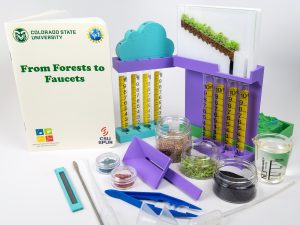
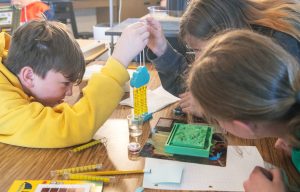
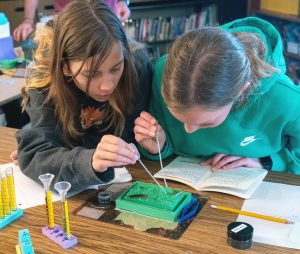
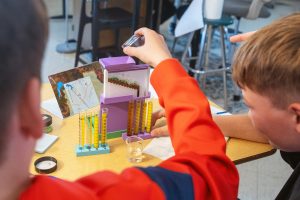
The storyline in this STEM kit takes students on an exploration of different aspects of the water cycle as they use a physical model to measure infiltration and runoff in forested and burned trials. Students then use a topographic model to analyze how precipitation patterns cause water scarcity on Colorado’s eastern slope and learn how people divert water under the Continental Divide. The kit mimics the science of Dr. Tim Covino’s lab at CSU!
NGSS Science and Engineering Practices include: 1) developing and using models; 2) analyzing and interpreting data; using mathematics and computational thinking; 4) obtaining, evaluating, and communicating information.
NGSS Crosscutting Concepts include:1) patterns; 2) cause and effect; 3) scale, proportion and quantity; 4) systems and system models; 5) stability and change of systems.
NGSS Disciplinary Core Ideas
- MS-ESS2.C The Roles of Water in Earth’s Surface Processes Water continually cycles among land, ocean, and atmosphere via transpiration, evaporation, condensation and crystallization, and precipitation, as well as downhill flows on land.
- MS-ESS3.A: Natural Resources Minerals, fresh water, and biosphere resources are limited, and many are not renewable or replaceable over human lifetimes.
- HS-ESS3.A: Natural Resources All forms of energy production and other resource extraction have associated economic, social, environmental, and geopolitical costs and risks as well as benefits. New technologies and social regulations can change the balance of these factors.
- HS-ESS3.C Human Impacts on Earth Systems The sustainability of human societies and the biodiversity that supports them require responsible management of natural resources.
Class Requirements
- 6th grade and up
- Moderate teacher preparation
- One to two class periods
- 30 students or less at a time
- Science notebooks
- Sink
- Paper Towels
From Forests to Faucets STEM Kit Resources
- From Forests to Faucets STEM Kit Use Instructions (complete teacher guide)
- From Forests to Faucets STEM Kit Instruction Booklet
(available upon request – email name and school to Dr. Andrew Warnock) - Science Notebook Template (for use in lieu of Science Notebooks)
- Science Notebook Template (Spanish version)
Borrowing From Forests to Faucets STEM Kits
There is no charge to educators who wish to borrow any of our STEM kits. We appreciate applications be submitted at least 2 weeks in advance of the desired use date. The Loan Application Form require you to confirm your email address before it will be sent to the NSEOC – so once you click submit, check your email (including the junk folder)! You should also get a copy of the form for your records via email, if you don’t, please contact Jordan Conley (jordan.conley@colostate.edu).
- For educators in the immediate area of Fort Collins (i.e.: Greeley, Loveland, Ault, Windsor, Johnstown, etc.), we ask that you select the local pick-up option on the Loan Application Form.
- For educators in Colorado outside of the immediate Fort Collins area, please select the local pick-up option on the Loan Application Form and the kits will be shipped to you.
- Educator Feedback Survey – must be completed after returning kits to the NSEOC and before another kit can be requested