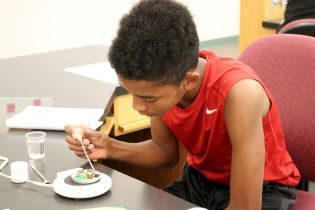
Explore how glaciers record past atmospheric events and permafrost thawing affects people!
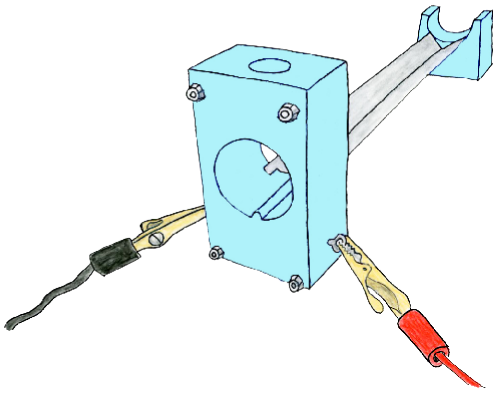
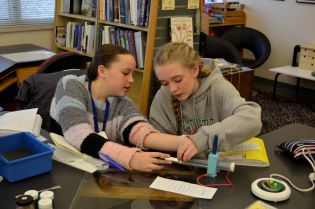
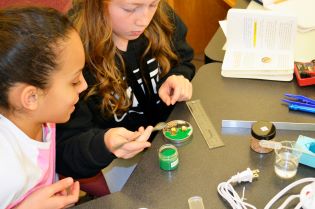
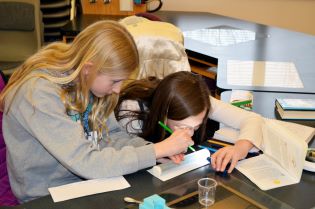
In this kit, students build a model with roads and buildings on permafrost and observe changes as the permafrost undergoes cycles of freezing and thawing. A second model of an ice core from the Ruth Glacier in Denali National Park is analyzed to identify annual layers, melt events, and volcanic ash deposits using authentic data. Students construct a timeline to discover what has happened in Alaska between 1880 and 2012.
Science and Engineering Practices include: 1) developing and using models; 2) analyzing and interpreting data; 3) using mathematics and computational thinking; 4) obtaining, evaluating and communicating information
Crosscutting Concepts include: 1) patterns; 2) cause and effect; 3) scale, proportion, and quantity; 4) systems and system models; 5) structure and function; 6) stability and change of systems
NGSS Disciplinary Core Ideas
- MS-ESS2.D: Weather and Climate Weather and climate are influenced by interactions involving sunlight, the ocean, the atmosphere, ice, landforms, and living things. These interactions vary with latitude, altitude and local and regional geography, all of which can affect oceanic and atmospheric flow patterns.
- MS-ESS3.D: Global Climate Change Human activities, such as the release of greenhouse gases from burning fossil fuels, are major factors in the current rise in Earth’s mean surface temperature (global warming). Reducing the level of climate change and reducing human vulnerability to whatever climate changes do occur depend on the understanding of climate science, engineering capabilities, and other kinds of knowledge, such as understanding human behavior and applying that knowledge wisely in decisions and activities.
- HS-ESS2.A: Earth Materials and Systems The geologic record shows that changes to global and regional climate can be caused by interactions among changes in the sun’s energy output or Earth’s orbit, tectonic events, ocean circulation, volcanic activity, glaciers, vegetation, and human activities. These changes can occur on a variety of timescales from sudden (i.e.: volcanic ash clouds) to intermediate (ice ages) to very long-term tectonic cycles.
- HS-ESS3.C: Human Impacts on Earth Systems The sustainability of human societies and the biodiversity that supports them require responsible management of natural resources.
Vital Ice STEM Kit Tutorials
- Vital Ice STEM Kit Use Instructions (complete teacher guide)
- Science Notebook Template (for use in lieu of Science Notebooks)
- Science Notebook Template (Spanish version)
- Vital Ice STEM Kit Instruction Booklet
(for more information, contact Andrew Warnock) - Using the Ice Core Scanning Device video (coming soon)
- Ice Core Graph Templates
- Global Surface Temperature Visualization
- Climate Change at Denali National Park
- What is an Ice Core?
- Temperature Changes in Alaska
- Valley of Ten Thousand Smokes
Borrowing Vital Ice STEM Kits
Educators in Alaska should contact Stacia Backensto at stacia_backensto@nps.gov or 907.455.0669 for information on how to borrow the kits – there are sets in Fairbanks and at Denali and Kenai Fjords National Parks that can be mailed out to teachers around the state.
Colorado Educators should contact the NSEOC through the loan applications below.
There is no charge to educators who wish to borrow any of our STEM kits. We appreciate applications be submitted at least 2 weeks in advance of the desired use date. The Loan Application Form require you to confirm your email address before it will be sent to the NSEOC – so once you click submit, check your email (including the junk folder)! You should also get a copy of the form for your records via email, if you don’t, please contact Jordan Conley (jordan.conley@colostate.edu).
- For educators in the immediate area of Fort Collins (i.e.: Greeley, Loveland, Ault, Windsor, Johnstown, etc.), we ask that you select the local pick-up option on the Loan Application Form.
- For educators in Colorado outside of the immediate Fort Collins area, please select the local pick-up option on the Loan Application Form and the kits will be shipped to you.
- Educator Feedback Survey – must be completed after returning kits to the NSEOC and before another kit can be requested
When one tugs at a single thing in nature, he finds it attached to the rest of the world. – John Muir