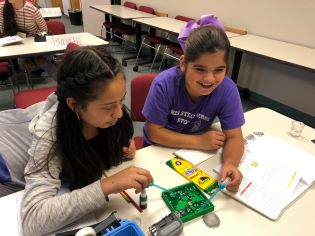
Explore where plastic comes from and how it moves through the ocean ecosystem
The story line of this kit traces the origin of plastic to plankton that settles on the ocean floor and gets buried by sediments. The thick layers of organic matter are converted to hydrocarbons by increased temperature and pressure. Humans extract these hydrocarbons (oil) and convert monomers to polymers to create a variety of difficult to recycle plastics. The plastic finds its way back into the ocean and gets eaten by plankton, coming full circle. The activities in this kit mimic the research of Dr. Ursula Quillman at CSU. This kit was developed by undergraduate students Andrew Allsup & Zoe Tauxe – read about them!
NGSS Science and Engineering Practices include: 1) developing and using models; 2) analyzing and interpreting data; 3) using mathematics and computational thinking; 4) constructing explanations and designing solutions
NGSS Crosscutting Concepts include: 1) patterns; 2) cause and effect; 3) scale, proportion and quantity; 4) systems and system models; 5) structure and function; 6) constructing explanations and designing solutions
Class Requirements
- 4th grade and up
- Moderate teacher preparation
- One to two class periods
- 30 students or less working in pairs
- Science notebooks
- Sink
- Paper towels
Plankton to Plastic Pollution STEM Kit Resources
- Plankton to Plastic Pollution STEM Kit Use Instructions (complete teacher guide)
- Settling Model Template
- Global Plastic Production Graph Template
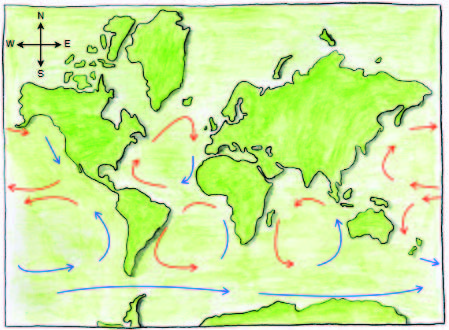
- 3D Printable Ocean Current Model (.stl File Format)
- Science Notebook Template (for use in lieu of Science Notebooks)
- Science Notebook Template (Spanish version)
- Plankton to Plastic Pollution STEM Kit Instruction Booklet (for more information, contact Andrew Warnock)
- Plancton a la Contaminación Plástica STEM Kit Instruction Booklet (for more information, contact Andrew Warnock)
- Oceanography at CSU
- Semester at Sea
NGSS Disciplinary Core Ideas
- 4-ESS2.E: Biogeology Living things affect the physical characteristics of their regions.
- 4-EEE3.A: Natural Resources Energy and fuels that humans use are derived from natural resources, and their use affects the environment in multiple ways. Some resources are renewable over time and other are not.
- 5-LS2.A: Interdependent Relationships in Ecosystems Decomposition eventually restores (recycles) some materials back to the soil.
- MS-PS1.A: Structure and Properties of Matter Solids may be formed from molecules, or they may be extended structures with repeating sub-units (e.g., crystals).
- MS-LS2.B: Cycle of Matter and Energy Transfer in Ecosystems Food webs are models that demonstrate how matter and energy are transferred between producers, consumers, and decomposers as the three groups interact within and ecosystem. The atoms that make up the organisms in an ecosystem are cycled between the living and non-living parts of the ecosystem
- MS-ESS2.A: Earth’s Materials and Systems The planet’s systems interact over scales that range from microscopic to global in size, and they operate over fractions of a second to billions of years. These interactions have shaped Earth’s history and will determine its future.
- HS-ESS3.A: Natural Resources All forms of energy production and other resource extraction have associated economic, social, environmental, and geopolitical costs and risks as well as benefits. New technologies and social regulations can change the balance of these factors.
Borrowing Plankton to Plastic Pollution STEM Kits
Educators in Mexico near CSU’s Todos Santos Center should contact Kim Kita at kim.kita@colostate.edu or 612-145-0009 for information.
Colorado Educators should contact the NSEOC through the loan applications below.
There is no charge to educators who wish to borrow any of our STEM kits. We appreciate applications be submitted at least 2 weeks in advance of the desired use date. The loan application forms require you to confirm your email address before it will be sent to the EOC – so once you click submit, check your email (including the junk folder)! You should also get a copy of the form for your records via email, if you don’t, please contact Jordan Conley (jordan.conley@colostate.edu).
- Local Pick-Up Loan Application Form – for educators in the immediate area of Fort Collins (i.e.: Greeley, Loveland, Ault, Windsor, Johnstown, etc.)
- Delivery Loan Application Form – for educators in Colorado outside of the immediate Fort Collins area
- Educator Feedback Survey – must be completed after returning kits to the NSEOC and before another kit can be requested
We can change the world and make it a better place. It is your hands to make a difference. – Nelson Mandela